Temu accounted for about a quarter of cross-border ecommerce sales in 2025, according to data published by the International Post Corporation (IPC).
That puts it in top-tier company, becoming the most-used cross-border ecommerce seller in 2025 along with Amazon, according to the IPC.
The IPC is an association of 26 postal operators across Asia-Pacific, North America and Europe. It surveyed more than 30,900 frequent cross-border online shoppers. It said its target group for the survey had bought physical goods online at least once in the last three months and had made a cross-border online purchase in the past year.
Among its findings are that, when placing an ecommerce order that requires cross-border shipping, most consumers (61%) require clear information on delivery charges before completing the sale. Meanwhile, about half consider low customs duties and reliable customer reviews as essential, IPC found.
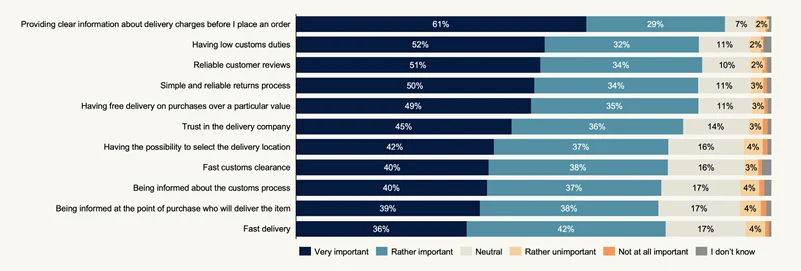
Consumer priorities for cross-border ecommerce orders in 2025. | Image credit: International Post Corporation
Amazon ranks third in Digital Commerce 360’s Global Online Marketplaces Database. That database ranks the 100 largest such marketplaces by third-party gross merchandise value (GMV). Temu is No. 14.

Temu’s role in the 2025 cross-border ecommerce market
IPC data indicates that Temu increased its share of cross-border ecommerce sales to 24% in 2025. That’s an increase from less than 1% in 2022, before it ran a Super Bowl ad in February 2023 that expanded its brand awareness in the United States.
Another marketplace competitor out of Asia, Shein, has held “a stable market share in the past two years,” according to the IPC. That followed what the IPC called “explosive growth” for Shein between 2020 and 2023.
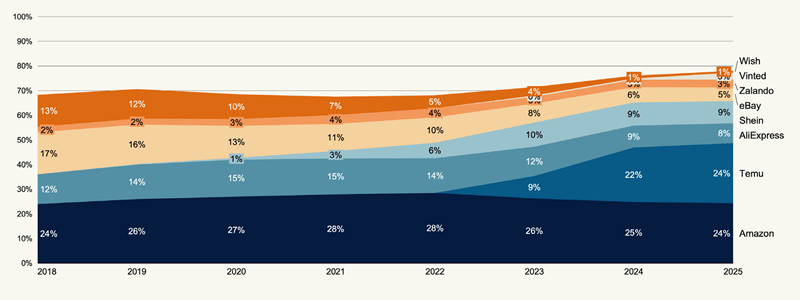
Market share of cross-border ecommerce sales by online marketplace in 2025. | Image credit: International Post Corporation
Shein ranks No. 67 in the Global Online Marketplaces Database. The Wish marketplace, which ranks No. 53, lost 95% of its share of cross-border ecommerce sales between 2018 and 2025, IPC data shows.
The IPC said eBay lost 68% of its market share in that time frame, while AliExpress lost 33%. In 2023, Amazon and AliExpress were the cross-border ecommerce sales leaders, according to IPC findings at the time.
Alibaba owns AliExpress as well as the world’s two largest online marketplaces by GMV, Taobao and Tmall. Both Taobao and Tmall operate in China and primarily serve the Chinese market. Among Alibaba’s other marketplaces is the global B2B marketplace Alibaba.com.
What consumers valued in cross-border online orders
The IPC asked consumers how long deliveries took between the point they purchased and when items reached them.
It found that more than half of cross-border sellers took between two and seven days to deliver orders. The most common transit times were 10-14 days (20% cited) and four to five days (19%).
IPC data indicates that deliveries were usually fastest for consumers purchasing from neighboring countries. Conversely, it was usually slowest for those purchasing from more distant markets.
Furthermore, the IPC found that the proportion of deliveries taking more than two weeks to reach their destination had decreased since 2020. That proportion fell to 7% in 2025 from 29% in 2020, the IPC said.
Close to half (44%) of deliveries went to consumers’ doorsteps, the most common option. Parcel lockers (13%) and deliveries directly to mailboxes (12%) were the next most common. The IPC said parcel lockers “increased significantly in usage in 2025,” without quantifying specifically.
Do you rank in our databases?
Submit your data and we’ll see where you fit in our next ranking update.
Sign up
Stay on top of the latest developments in the online retail industry. Sign up for a complimentary subscription to Digital Commerce 360 Retail News. Follow us on LinkedIn, X (formerly Twitter), Facebook and YouTube. Be the first to know when Digital Commerce 360 publishes news content.
Favorite