Mirakl has been extending its list of clients using its catalog transformer to list products online — whether through a marketplace or an AI agent.
Mirakl provides technology that enables companies to create their own marketplaces or sell on existing ones. And it provides essentially the same technology for wholesalers in the B2B context as it does for retailers selling directly to consumers.
The differences, according to Scott Eckert, CEO of the Americas at Mirakl, largely come down to B2B-specific features such as buying using purchase orders rather than credit cards.
“Just a little under 20% of Mirakl’s business is B2B transactions,” Eckert told Digital Commerce 360. “It’s a vibrant part of the business we do. You probably wouldn’t know the brands typically because what they’re often doing is they’re building a connection to their distributors, or they’re trying to coordinate parts and distributing parts to dealers. And so if you think about it, the distributors buying from a central organization look a whole lot like people buying off a marketplace.”
What is the Mirakl catalog transformer?
The catalog transformer is an AI-enabled tool that Mirakl built using its own proprietary language models. Mirakl said the tool automates product catalog optimization at scale. It enables companies to apply attributes to their product across catalogs. The tool refines attributes based on where the company wants to sell them, Eckert said. Mirakl uses the catalog transformer within what it calls Mirakl Connect.
Mirakl Connect is an AI-powered multichannel selling solution for both B2B and B2C clients. The technology company launched Mirakl Connect in 2019, calling it a way of “connecting marketplace operators with sellers and partners.”
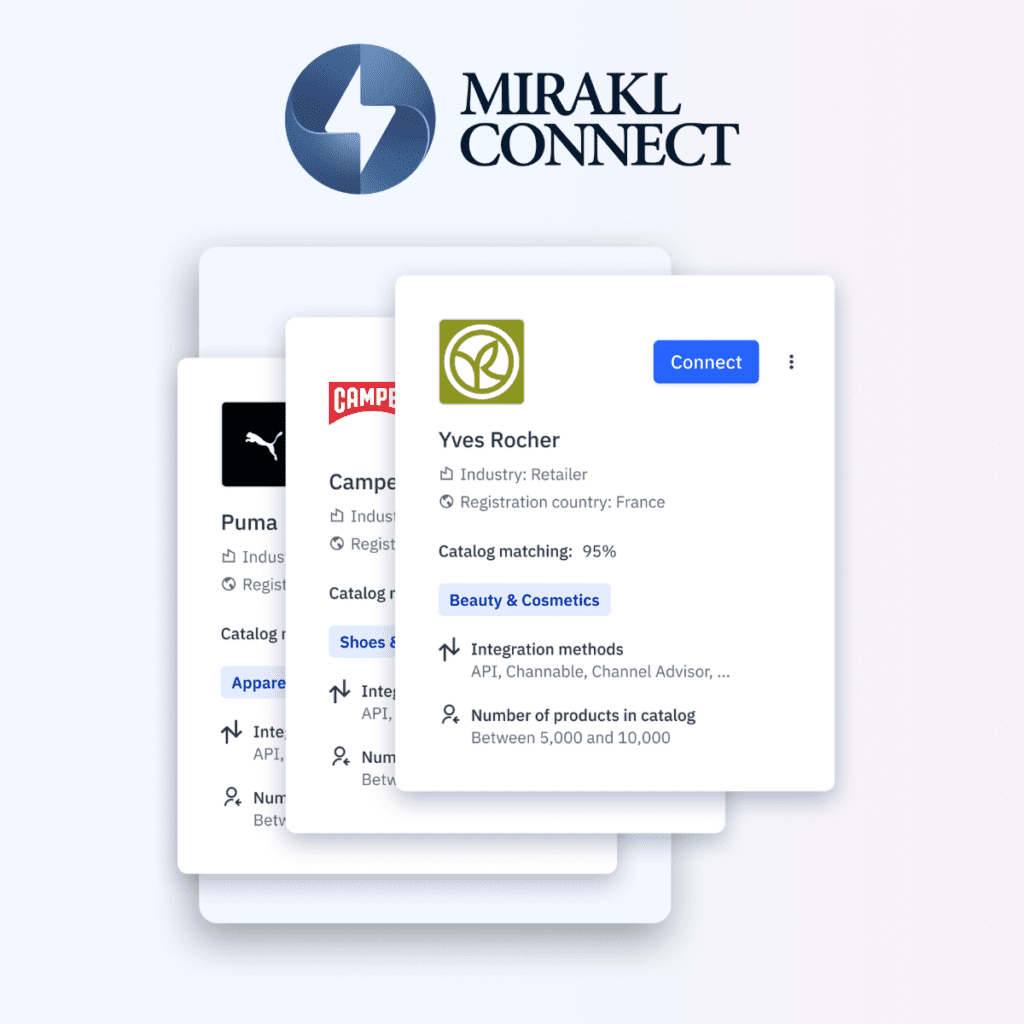
Mirakl Connect displays potential integrations for customers. | Image credit: Mirakl
He noted that B2B companies “are often roll-ups of acquisitions.” As such, they have different products, businesses and information systems to meld together. That aggregation service is a strong use case for the catalog transformer, he said.
One example is with Bunzl, an international distribution and services group. In April, Mirakl and Bunzl launched BunzlOne. They touted that with 160 companies across 32 countries, Bunzl sources, consolidates and delivers products worldwide. Now, it uses a single catalog with real-time availability and enterprise-specific pricing across multiple Bunzl companies, they said.
The Bunzl announcement came the month after outdoor power equipment maker STIHL launched a B2B marketplace through Mirakl.
How B2B companies can use Mirakl’s catalog transformer
“What Mirakl is great at is if you have a many-to-many marketplace — lots of different sellers, lots of different buyers — we help put those together,” Eckert told Digital Commerce 360.
In one case, he said, Mirakl enabled a hotel chain to optimize mass purchases of towels for 1,000 locations. He gave another example of an auto parts supplier working to ensure all its dealerships can order a unique part for its cars from one place where it can centralize the ordering.
Eckert said the catalog transformer primarily serves two interconnected purposes: enrichment and optimization.
The enrichment process makes sure each product has the right type of image for the channel that a company is selling through. Mirakl also extracts attributes from those images, Eckert said. From there, the catalog transformer uses those attributes to build descriptions of how to use products.
The optimization uses Mirakl’s knowledge of what is uniquely important for each large language model (LLM) and marketplace. That changes with every update, making it a dynamic space, Eckert said. Mirakl constantly updates the catalog transformer to account for the different parameters AI agents are looking for, he added.
“The end result is a richer set of data than what a customer might see when they’re surfing the web and looking at a product data page,” Eckert said. “Behind that is actually a whole — that you don’t see because it’s designed to be machine-readable, not human readable — is a whole rich set of data that’s been optimized for the different AI agents.”
Sign up
Sign up for a complimentary subscription to Digital Commerce 360 B2B News. It covers technology and business trends in the growing B2B ecommerce industry. Follow us on LinkedIn, X (formerly Twitter), Facebook and YouTube.
Favorite