Boat Trader, the nation’s largest online boating marketplace, is expanding its use of artificial intelligence (AI) with new features that aim to simplify shopping, broaden dealer visibility, and draw new buyers into the boating market.

John Barrile, chief technology officer, Boats Group | Image credit: Boats Group
In late September, the company introduced natural language search on its website and added an AI-powered image recognition tool to its mobile app. It designed the upgrades to modernize the boat-buying process, which has traditionally relied on filtering through long lists of makes and models. By allowing users to type or even photograph what they are looking for, Boat Trader is betting that technology can lower barriers for new buyers while delivering higher-quality leads for dealers.
The centerpiece of the rollout is a natural language search function that lets users type queries the way they would speak. Shoppers can now enter phrases such as “family cruiser with cabin under 40 feet,” “pontoon boat near me for weekend use,” or “MarineMax Florida” and receive tailored results within seconds.
This marks a change from past searches, which forced buyers to navigate through rigid filters or use a separate “Find a Dealer” page that displayed only one location at a time. Now, users can search dealer names directly in the main bar, integrating inventory and dealer discovery in one step.
“The smart search experience is about removing friction and making it easier for people to shop the way they naturally think,” said John Barrile, chief technology officer at Boats Group, Boat Trader’s parent company. “From boat type to dealer name, buyers can now find what they want in fewer steps. That not only improves the shopping experience but also drives more meaningful exposure and higher-quality leads for our sellers.”

The Boat Trader homepage shows an option to search for boats by types or manufacturers. | Image credit: Boats Group
How Boat Trader is using AI
The company said the results are already measurable. Since the new search launched, Boat Trader has seen a 5% increase in lead conversion across the platform.
On mobile, Boat Trader has taken a different approach. The company’s app now allows shoppers to upload or snap a photo of a boat to identify its make and model. The app will surface either exact matches or, if none are available, comparable listings with comparable characteristics.
“You can actually take a picture or upload a picture of a boat, and it’ll tell you what the make and model is,” Barrile said. “If there’s no exact match, we’ll find comparable listings with similar characteristics, and it’ll list them out for you so you can start searching that way. The idea being, ‘Hey, that boat looks cool. What is it?’ You can click on it and pull it right up.”
The tool is powered by one of the world’s largest boat image libraries, built by Boats Group over years of cataloging inventory. That database gave the company the resources to train multiple AI models capable of recognizing boat types. It boasts accuracy rates of 70% to 90%, depending on the model.
Challenges remain for unusual boats, discontinued models, or vessels with subtle differences not captured in a photo. But Barrile said the system performs well, even from a distance.
“It does actually work,” he said. “We’re a quarter mile from the water here, and you can take pictures at a distance from the app. It’s spot-on with those.”
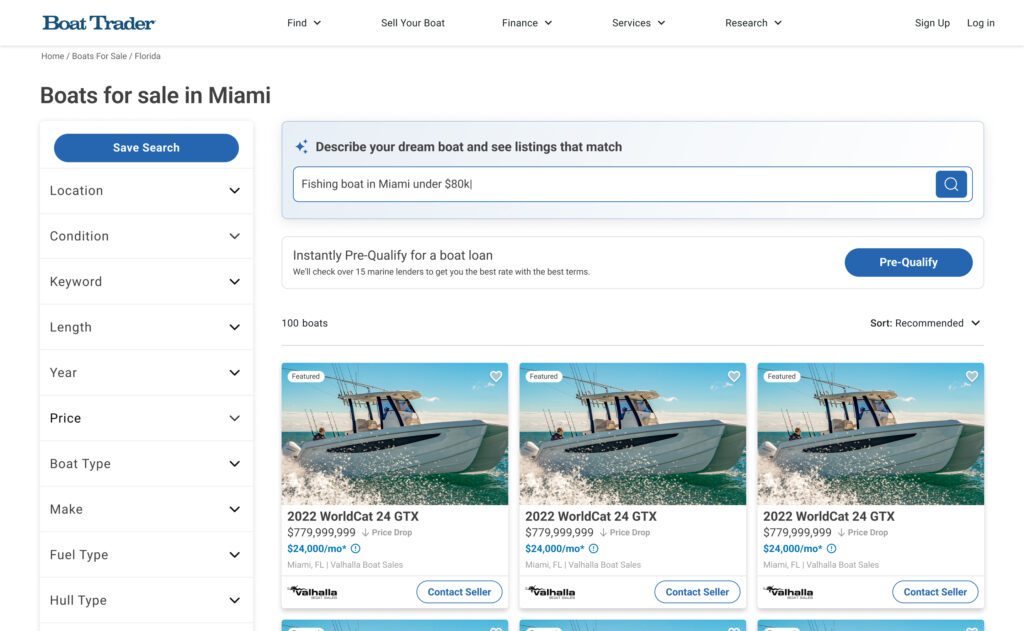
Boat Trader uses artificial intelligence (AI) for its website search. | Image credit: Boats Group
First Boat Trader project using AI
Barrile said the decision to launch image recognition as Boat Trader’s first AI project reflected both practical and strategic factors. The company already had the technical infrastructure and data to support it, and the feature provided a way to engage people who might be unfamiliar with boating.
“When you think about it, even here in Miami, people go out on boats all the time with their friends,” he said. “They might not own a boat, and they don’t know much about them, but they’re curious. This gives them an opportunity to find out what they’re looking for. It brings potential new buyers into the marketplace by lowering the knowledge barrier.”
The project also changed how Boat Trader approaches AI development. Instead of embedding initiatives in broad, long-term roadmaps, the company assigned small teams to pursue projects independently. That approach, Barrile said, built “muscle memory” for quick execution and created a model for future rollouts.
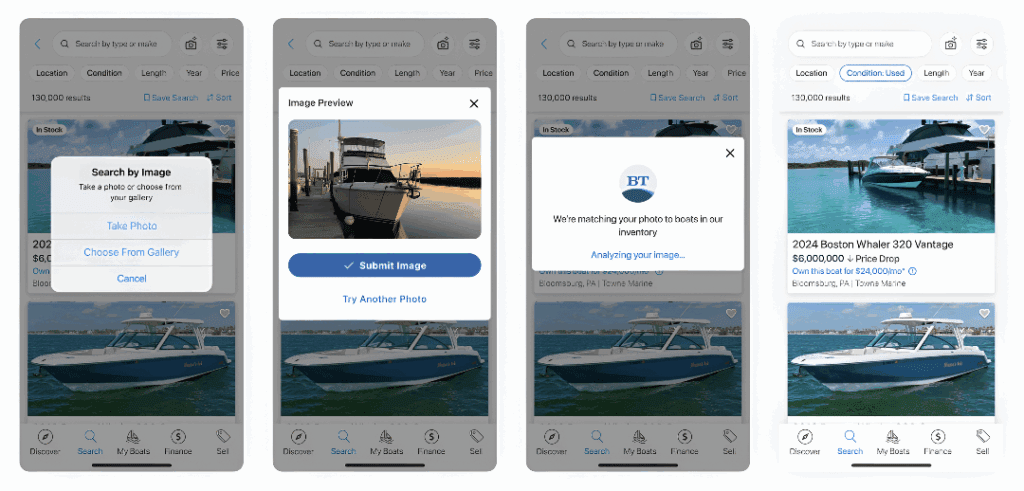
Boat Trader’s app allows users to submit an image to identify boats. | Image credit: Boats Group
Reaching millennial and Gen Z boat buyers
The natural language search builds on those lessons and targets younger demographics less familiar with boat brands. Barrile noted that boating traditionally skews older. However, the company sees an opportunity to spark interest among millennials and Gen Z.
“In the boating marketplace generally, demographics have skewed older,” he said. “The idea is how do you get millennials, for example, out on the water, interested in boats, when they don’t even know where to start? Historically, you had to filter specific make and models. Now you can just type, ‘I want a fun fishing boat under $30,000 near me.’ And that at least gets them started. You see good intent from those searches, and that has led to higher conversion.”
For dealers, the new tools offer broader visibility to prospective buyers who might not have narrowed their search to a particular brand. Lifestyle prompts can surface listings that otherwise might not be seen, while direct dealer name searches allow buyers to view full inventories more easily.
“The improvements benefit both sides,” Barrile said. “Buyers get easier discovery, and sellers get better leads.”
By combining natural language and image recognition, Boat Trader is moving toward making boat shopping feel more like buying cars or homes online: intuitive, visual, and simple. The company hopes the upgrades will not only modernize the search experience but also expand the pool of potential buyers.
“We see technology as a way to broaden the boating market,” Barrile said. “It’s about making discovery easier, connecting buyers and sellers faster, and lowering the barrier for people who might never have thought about owning a boat before.”
Sign up
Sign up for a complimentary subscription to Digital Commerce 360 B2B News. It covers technology and business trends in the growing B2B ecommerce industry. Contact Mark Brohan, senior vice president of B2B and Market Research, at mark@digitalcommerce360.com. Follow him on Twitter @markbrohan. Follow us on LinkedIn, X (formerly Twitter), Facebook and YouTube.
Favorite