


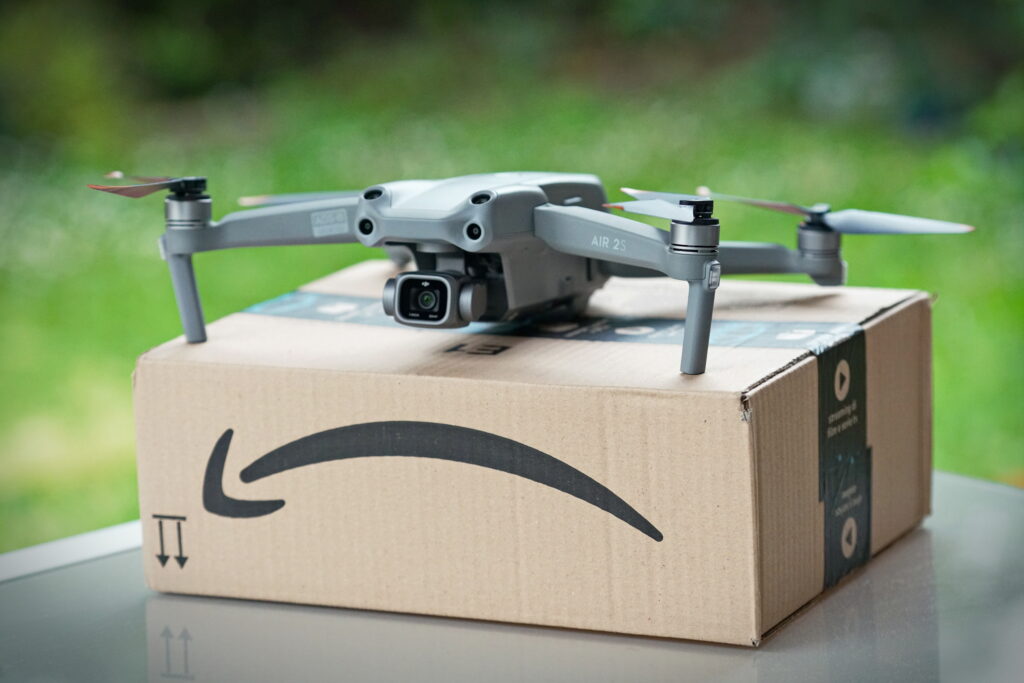
Amazon.com Inc. is expanding its Prime Air drone delivery to five more U.S. metro areas, the online retail giant announced Aug. 19.
The fast-delivery service is slated to launch “soon” in the Chicago, Syracuse, Cleveland, Atlanta and Boise markets, with more communities to follow later this year, Amazon said in a blog post.
The expansion is part of Amazon’s plan to reach nearly 500 U.S. cities and towns by the end of 2026 — a footprint six times larger than today, the company said. Prime Air currently operates in 10 metro areas across:
- Arizona
- Florida
- Kansas
- Louisiana
- Michigan
- Nebraska
- Texas
Amazon ranks No. 1 in Digital Commerce 360’s Top 1000 Database. The market research tool tracks North America’s largest online retailers by their annual ecommerce sales.
However, Amazon is No. 158 in Digital Commerce 360’s all-new AI Rankings. That set of rankings is available in the Top 1000 Pro with AI Database.
Amazon is also No. 3 in Digital Commerce 360’s Global Online Marketplaces Database. That database ranks the 100 largest such marketplaces by third-party gross merchandise value (GMV).
Where Amazon offers Prime Air
Presently, Amazon said Prime Air serves the following U.S. metro areas:
- Baton Rouge
- Dallas
- Detroit
- Houston
- Kansas City
- Omaha
- Phoenix
- San Antonio
- Tampa
- Waco
The list marks a sharp increase from spring 2025, when Tolleson, Arizona, and College Station, Texas, were its only active U.S. test markets. Prime Air also recently launched in Darlington, England, its first market outside the U.S.
So far this year, the service has delivered “hundreds of thousands of packages,” David Carbon, vice president of Amazon Prime Air, said in the company’s latest blog post on the subject. The company claims its sites make thousands of deliveries daily and have the highest average delivery volumes in the U.S.
How Amazon Prime Air works
Its U.S. drones launch from sites serving an area of about 175 square miles. While Prime Air orders can arrive in as little as 30 minutes, most take about 60 minutes from checkout to delivery, the company said.
Across most Prime Air locations, Amazon said customers can choose from “millions” of products. These range from groceries and cosmetics to medications and electronics. To qualify, items must weigh 5 pounds or less and fit inside a large shoebox. Amazon said this covers “more than 60% of the items customers are most frequently purchasing.”
On drone orders of at least $50, Prime members pay no fee. Smaller Prime orders incur a $2.99 fee, while non‑Prime orders carry a $4.99 fee.
For shoppers in covered areas, a drone delivery option appears automatically while browsing eligible products and at checkout. Amazon said orders use its standard app, checkout process and returns system.
When placing their first order, customers must choose an outdoor delivery point, such as a driveway or yard. They can keep that location for future deliveries or select a different drop-off point at any time. When the drone arrives, it checks for people, pets, vehicles and other obstacles before releasing the package, Amazon said.
To handle more delicate cargo, the company is currently testing a tethered “gentle delivery” system, Carbon told employees in March, according to CNBC.
Prime Air adds to Amazon’s other fast‑delivery options, including 30‑minute delivery through Amazon Now and one‑hour, three‑hour and same‑day delivery in eligible markets.
“Customers continue to demand faster delivery times,” Carbon said in March. “Bottom line is we have yet to reach diminishing returns when it comes to how fast we deliver to our customers.”
Setbacks Amazon Prime Air has faced
When Amazon founder Jeff Bezos first unveiled drone delivery in 2013, he predicted it could arrive within four or five years. Commercial U.S. deliveries, however, didn’t begin until late 2022, when Prime Air launched in Lockeford, California, and College Station, Texas.
In May 2024, the Federal Aviation Administration (FAA) authorized Prime Air to fly beyond a remote operator’s visual line of sight, clearing a major regulatory hurdle.
Later that year, Amazon began deploying its newer MK30 drone, which can fly in light rain and operate within about 7.5 miles. The company said the drone is lighter, quieter and flies twice as far as its predecessor.
In January 2025, Amazon paused U.S. deliveries for two months after flight data indicated that dust could interfere with the MK30’s altitude sensor. To fix the issue, the company deployed a software update and resumed deliveries after receiving FAA approval.
In October 2025, the program faced scrutiny when two MK30 drones collided with a crane near Amazon’s launch site in Tolleson, prompting the FAA and National Transportation Safety Board to open investigations. At the time, Amazon said it completed an internal review and found no issue with the drones or supporting technology. The company said it added improved visual inspections to better monitor moving obstructions, such as cranes.
In its latest blog post, Amazon cited the safety systems it says will support Prime Air’s expansion. Its drones use onboard cameras and sensors to navigate, and a “detect-and-avoid” system continuously monitors airspace and the environment for obstacles. This enables drones to “independently see and make real-time decisions while in flight,” Amazon said.
From a privacy standpoint, the company said camera data is processed on the aircraft and that no employee monitors a live video feed. It added the drones do not track individuals or record their movements.
Drone delivery competition grows
By the end of 2026, Amazon expects Prime Air to serve communities with 30 million customers, CEO Andy Jassy told shareholders in his April letter. Longer term, Amazon aims to deliver 500 million packages per year by drone by the end of the decade, Jassy wrote.
The expansion comes as competitors build out their own drone networks.
In May, Walmart announced that its drone service, operated alongside partners such as Wing and Zipline, had surpassed 1 million deliveries. Walmart ranks No. 2 in Digital Commerce 360’s Top 1000 Database.
Walmart and Alphabet Inc.-owned Wing plan to build a network of more than 270 drone delivery locations by 2027. This would reach over 40 million Americans across nearly 20 U.S. markets in what they describe as the nation’s largest drone network.
Meanwhile, Zipline is expanding beyond its roots of delivering medical supplies in Africa. On Aug. 17, the company announced a strategic partnership with Uber Technologies Inc. to scale drone deliveries across the U.S., with the first Uber Eats drone drop-offs slated to launch later this year.
As part of the deal, Uber is making a strategic investment in Zipline. Together, the companies said they aim to reach one million daily drone deliveries by late 2029
In July, rival DoorDash announced DoorDash Air, an in-house drone program being developed by its DoorDash Labs robotics unit, after earning an air carrier certification from the FAA.
A company spokesperson told Business Insider that commercial deliveries are expected to begin in fall 2026. DoorDash has not named any initial launch markets. The company said its drones could help handle “mid-range” orders traveling three to five miles.
Do you rank in our databases?
Submit your data and we’ll see where you fit in our next ranking update.
Sign up
Stay on top of the latest developments in the online retail industry. Sign up for a complimentary subscription to Digital Commerce 360 Retail News. Follow us on LinkedIn, X (formerly Twitter), Facebook and YouTube. Be the first to know when Digital Commerce 360 publishes news content.
Favorite