

Lush Cosmetics has announced a partnership that places it on the Instacart platform, providing same-day delivery in the U.S. and Canada.
The companies said their partnership will enable same-day delivery as fast as one hour after a customer places an order. Their partnership capitalizes on the cosmetics retailer’s 250 stores across the two countries.
Consumers shopping Lush Cosmetics on Instacart will have access to more than 600 products “with no markup,” according to the companies. However, fees still apply. The companies said item prices reflect the average in-store prices that the retailer provides in consumers’ respective areas. Additionally, items on sale in Lush Cosmetics’ physical stores may not be on sale through the Instacart platform.

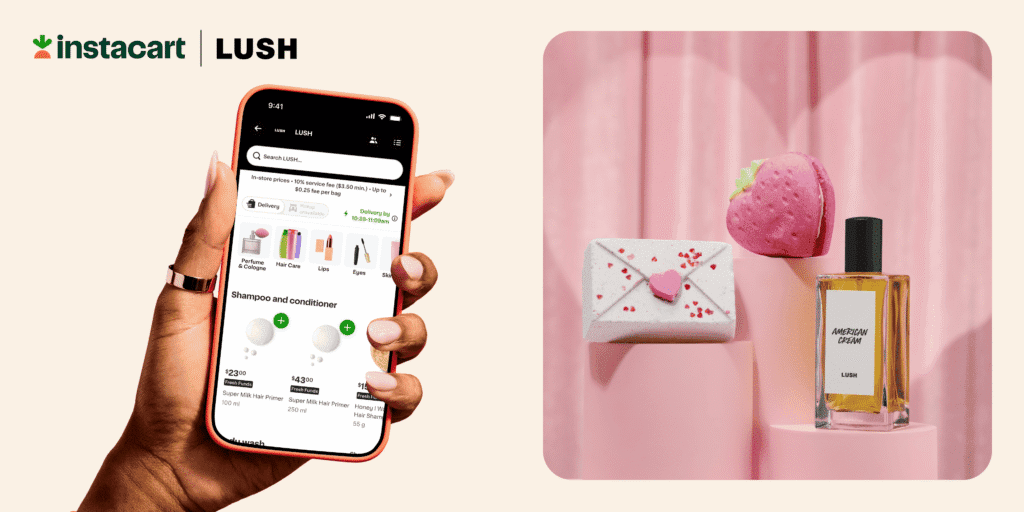
Lush Cosmetics joins more than 1,800 national and local retail brands on the Instacart App, the companies said. They highlighted Lush’s storefront on Instacart’s app. | Image credit: Lush and Instacart
Lush Cosmetics operates in 50 countries with more than 850 physical locations, 38 ecommerce websites that offer worldwide shipping, as well as mobile apps. It ranks No. 269 in the Europe Database. The proprietary Digital Commerce 360 database tracks the largest 500 online retailers in that region based on their annual ecommerce sales and more.
Why Lush Cosmetics joined the Instacart platform
Raman Khtaria, head of digital operations at Lush Cosmetics in North America, said in a statement that the brand “prioritizes fresh, high-quality, and sustainably harvested ingredients.”
“With Instacart, we’re expanding customers’ accessibility to Lush’s handmade product inventions, making them easier to access than ever before,” Khtaria said.
Lush Cosmetics joins a variety of retailers — across merchandise categories — that have partnered in recent months with last-mile delivery platforms.
Instacart said Lush Cosmetics joins more than 1,800 national and local retail brands on the Instacart App. Those brands span grocery, pet, household and wellness categories, Instacart said.
Lush Cosmetics did not announce an Instacart expansion outside of the U.S. and Canada. Meanwhile, about a week before Lush’s announcement, Costco expanded its partnership with Instacart into Spain and France.
Then, 1-800-Flowers.com announced its own partnership with Instacart ahead of Valentine’s Day. Similarly, Lush Cosmetics has timed its release ahead of Valentine’s Day to offer last-minute gifting options. It said consumers can shop its signature assortment — which includes bath bombs, face masks, body scrubs and shampoo bars — via Instacart.
“We’re always looking for meaningful ways to bring even more convenience to people who shop with Instacart,” said Blake Wallace, vice president of retail partnerships at Instacart. “By teaming up with Lush, we’re helping people bring fresh, handmade essentials straight to their door — perfect for gifting, stocking up, surprising a loved one with some self-care for Valentine’s Day, or all year round.”
Report: Valentine’s Day marketing lessens in 2026
Although both Lush Cosmetics and 1-800-Flowers.com have offered promotions ahead of Valentine’s Day, data from ecommerce marketing company Omnisend indicates a shift in 2026.
It found that Valentine’s Day marketing activity has decreased 52% year over year between Jan. 1 and Feb. 11. Brands sent half as many Valentine’s Day-related email campaigns in that time frame compared to 2025. Omnisend tracked 3,072 Valentine’s Day-related email campaigns in early 2026, compared to 6,395 in 2025.
However, total email volume among those brands more than doubled (133% growth). That suggests brands did not slow down their marketing overall, according to Omnisend. Instead, “they simply deprioritized Valentine’s Day.”
Overall email marketing activity increased to 168,128 over the same time frame. That compares to 72,134 campaigns in the first few weeks of 2025.
“The data shows a clear strategic shift,” said Marty Bauer, ecommerce expert at Omnisend, in a statement. “Brands are sending significantly more emails overall, but Valentine’s Day has lost prominence in the marketing calendar. Retailers appear to be responding to more cautious consumer spending behavior.”
Separate Omnisend survey data of 1,000 U.S. consumers in January found that nearly a quarter (23%) of consumers have reduced or stopped buying holiday gifts — including for Valentine’s Day — over the past 12 months in an effort to save money. At the same time, nearly half of shoppers report spending more online per month than they did a year ago, according to Omnisend.
It found rising costs have driven the increase rather than high consumption. 39% of consumers attributed increased spending to inflation. 24% cited tariffs and trade policies. Meanwhile, 23% noted higher shipping and delivery costs.
“Shoppers aren’t necessarily buying more — they’re paying more,” Bauer said. “When budgets feel tighter, discretionary holidays like Valentine’s Day are often the first to be scaled back.”
Do you rank in our databases?
Submit your data and we’ll see where you fit in our next ranking update.
Sign up
Stay on top of the latest developments in the online retail industry. Sign up for a complimentary subscription to Digital Commerce 360 Retail News. Follow us on LinkedIn, TikTok, X (formerly Twitter), Facebook and YouTube. Be the first to know when Digital Commerce 360 publishes news content.
Favorite