

Canada-based direct-to-consumer brand Manmade started to address a single issue: uncomfortable underwear.
Co-founder Anthony Ciavirella told Digital Commerce 360 that he and the other three co-founders — Philip Santagata, Robert Marzin, and Roberto Rebelo, who “were all finance guys” — had an entrepreneurial itch. And maybe a literal itch, as well. The four had been on a walk on a hot and humid summer day when they realized they were unhappy with the quality of their underwear. They knew they wanted to start their own brand in the ecommerce space, Ciavirella said, but until then, they didn’t know what they wanted to sell.
Upon looking into materials to make their shared vision a reality, the four of them decided against cotton because it stretches out, and against polyester because it’s derived from plastic and is not as healthy to wear on a day-to-day basis, Ciavirella said. At that point, it came down to two fabric choices: One made from bamboo, and the other from beech tree. They opted for the latter, using a material called modal.
The retailer sells just one cut of boxer briefs, available in either black or blue. It sells the briefs for $22 per pair, which Ciavirella said is at least $10 cheaper per pair than other boxer briefs made from the same fabric.
“We don’t have to invest in different SKUs,” Ciavirella said. “We don’t have to do any discounts. No promo codes.”
Instead, Manmade worked to bring down its standard price, reserving reduced prices for high-volume orders.
“We got it to the cheapest possible point where it’s functional, meaning it’s a good price, it’s fair,” Ciavirella explained. “If you want a reduction in price, you have to buy seven, and then it comes down two dollars a pair. We have it in stock every time you need it. There’s no inventory chaos.”
Since developing the boxer briefs, Manmade has also begun selling socks, T-shirts and hats. Looking ahead, it plans to sell pants and swim trunks, Ciavirella said.

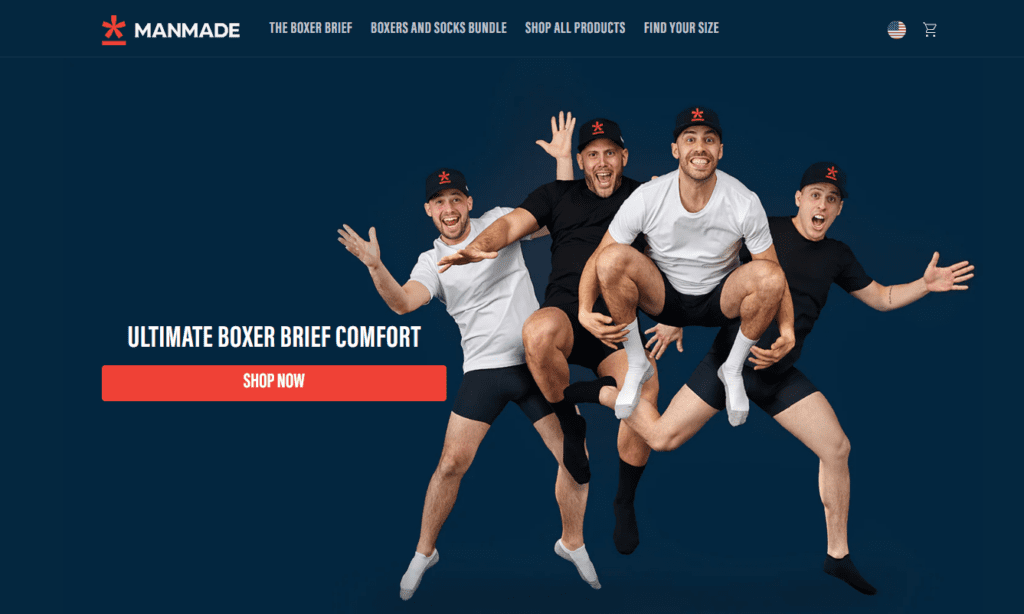
Direct-to-consumer apparel brand Manmade focuses its marketing message on the comfort of its boxer briefs.
Building a business, starting with the bottoms
It took Manmade a year to develop its first product, the boxer briefs, before it could officially launch three years ago in August. Starting the company, Ciavirella and his co-founders had to figure out how to source their product, market it, and generate enough sales to grow steadily.
If Manmade were to produce its garments in Canada, Ciavirella said, it would have to charge tens of dollars more per pair of boxer briefs, even if Manmade got the best possible price from its supplier.
“That’s totally different business,” Ciavirella told Digital Commerce 360. “We knew that it was a market that we didn’t wanna enter at $60.00 per pair. So we went with the second-best option, and that’s our manufacturing partners in Sri Lanka, Vietnam.”
In addition to partners in those countries, Manmade also works with suppliers in Cambodia and Taiwan, he added.
Early on, Manmade had built its own website and customer retention management (CRM) tools it used. It even had its own text messaging platform through which customers could place orders. Since then, Manmade has switched to ecommerce platform provider Shopify. Its website includes the option to display its Canadian pages in either English or French, and its U.S. pages in either English or Spanish.
In North America, 117 of the Top 1000 online retailers use Shopify as their ecommerce platform. The Top 1000 is Digital Commerce 360’s database of the largest online retailers in the region by annual web sales. In 2023, those 117 online retailers combined for more than $9.72 billion in web sales.
Manmade opts for direct-to-consumer sales over wholesale
“We’ve been approached many times to do wholesale, but we prefer direct-to-consumer for multiple reasons,” Ciavirella said. “One of them: We control the experience for the customer.”
Manmade realized that selling wholesale would mean sharing 50% of the company’s profits or margins with a third party, he said.
“Yes, they have a brand, and they have a store, and they have foot traffic; but why not open your own store?” he said.
So, rather than wholesaling to put its products in retail stores, Manmade is looking into opening its own retail space “by next year,” he added.
Selling direct-to-consumer, Manmade has grown at a rate of 300% year over year, Ciavirella told Digital Commerce 360. In August 2024, it sold nearly 40,000 orders. Manmade projects to sell 2.5 to three times that amount in November and December, he added, with the goal of growing 300% again for the next three years.
And although Manmade is working on “solidifying the Canadian market,” it’s simultaneously focused on its sales to the United States, which account for 30% of its global sales.
Manmade marketing strategy
Manmade hasn’t started putting the same marketing efforts into U.S. sales as it has for Canada, Ciavirella said. But it has already learned some lessons about what works for the brand — and what doesn’t.
For example, Manmade’s earliest ads featured its co-founders as models wearing the retailer’s products. They then had the idea of putting female models in Manmade boxer briefs to get men’s attention.
“That was an absolute fail, and that didn’t do well,” he said.
Manmade’s “big break,” he said, was being featured in a front-page article in the Montreal Gazette. That helped Manmade sell its first thousand orders.
“I’ll never forget it,” he said. “We worked 48 hours in a row. It was absolutely insane. The conference room that I’m in now is where we used to pick and pack and have all our inventory.”
Ciavirella said after packing all those orders with his team, he called every customer who had purchased to ask what resonated with them about Manmade. For the most part, he said, it came down to the brand’s story. It made many customers curious enough to give the boxer briefs a try.
That’s when the co-founders met and decided they need to build the brand with their faces and story at the forefront.
“All these things, yes, they happened in a technically short period of time, but there was a lot of effort, and there was a lot of trial and error, and there was a lot of figuring it out and meeting the right people to get to that point,” Ciavirella said.
Do you rank in our databases?
Submit your data and we’ll see where you fit in our next ranking update.
Sign up
Stay on top of the latest developments in the online retail industry. Sign up for a complimentary subscription to Digital Commerce 360 Retail News. Follow us on LinkedIn, X (formerly Twitter), Facebook and YouTube. Be the first to know when Digital Commerce 360 publishes news content.
Favorite