


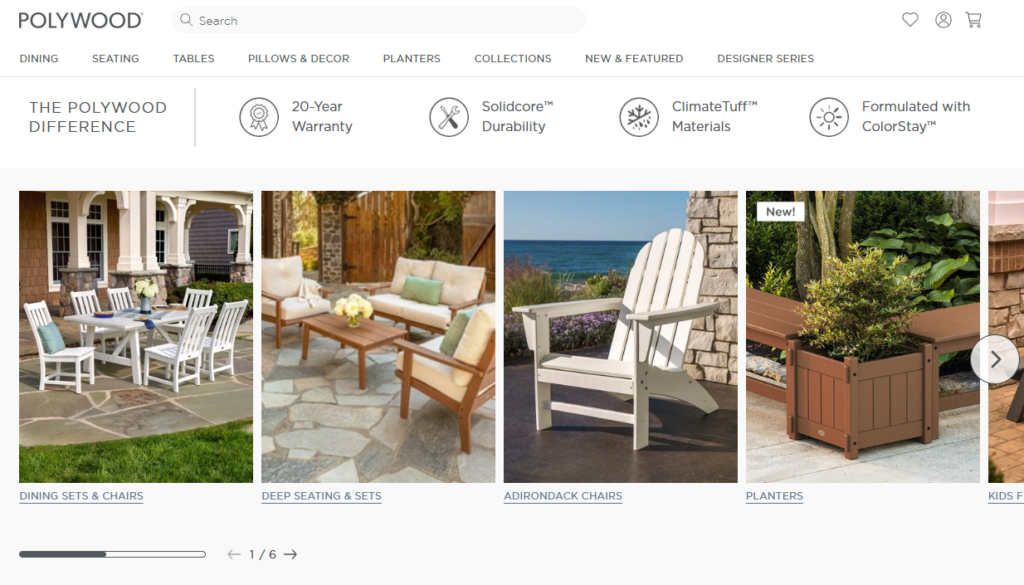
When Ben Spiegel joined Polywood in 2025, he didn’t anticipate 75% of the outdoor furniture retailer’s sales would come from ecommerce.
He joined the retailer as chief information officer in April 2025 before becoming chief digital officer about a year later. Prior to that, he worked at Health & Beauty and consumer-packaged goods merchants, where sales are largely online. But his expectations for Housewares & Home Furnishings were different.
“I didn’t really expect coming into the category that people would do that,” Spiegel told Digital Commerce 360. “I realized quickly that that’s driven by: you can’t get good products locally — the ones that you want —meaning you go in a showroom and you see something, but it’s not the right color, not the right size, not the right availability. So I’ve been really impressed by our D2C demand and the demand to transact online in this category.”
He identified what he considered to be a problem in the category: Mass Merchants and Home Improvement retailers sell a few outdoor furniture products each. Additionally, consumers ordering from “some obscure vendor” wouldn’t know when a product will arrive or what brand it is.
In addition to selling direct-to-consumer (DTC), Polywood sells wholesale and through showrooms.
Polywood’s made-to-order delivery process
“The interesting part about our businesses is it’s vertically integrated, just-in-time manufacturing, meaning you literally click on checkout on Shopify and it triggers lumber being moved to a machine, being extruded, being cut and being shipped to you,” Spiegel said. “So [it’s] this whole idea of one-piece flow versus manufacturing massive amounts of inventory and then trying to push it.”
Upon ordering, Polywood products generally ship out in about five to seven business days, according to Spiegel. He estimated that the retailer keeps a maximum of 5% of its inventory on hand.
“We make each piece custom,” Spiegel said. “That means we can give a massive assortment without having to worry about carrying too much inventory, which is a really different approach.”
Polywood’s peak sales periods
As a brand for outdoor products, the vast majority of Polywood’s business — around 80% — occurs between Memorial Day and Labor Day. May alone is a key month for the retailer.
It largely limits itself to sales around those two holidays, but it participates in other promotional periods in different ways. For example, during the Cyber 5, Polywood tends to avoid discounting. However, it might offer faster shipping or limited-time products.
Polywood also sells via Amazon and experienced an increase in traffic during the marketplace’s Prime Day event in June this year.
“It was a noticeable spike, and the main issue with this spike is that it was a lot of add to carts and comparison shopping,” Spiegel explained. “Our average purchase price is about $1,600, so we are not as much in the realm of the spontaneous, ‘Hey, I’m emotionally triggered to buy this right now,’ and a lot more in this space of ad planning the purchase.”
In fact, Polywood’s approach to Prime Day is to reduce ad spend. Such promotional periods are when Polywood might sell chairs at the retailer’s lowest price points, he added. That compares to selling dining or deep-seating sets during its busier periods.
“If you’re searching for a dining set and you see Polywood at full price and everybody else at a discount price, it doesn’t really make sense,” Spiegel said.
Polywood also offers sales centered around the 4th of July. This year’s didn’t go as well as 2025, though, he said.
“We see the higher-income level, higher-priced product is not impacted as much,” Spiegel said. “We see the lower-household income/household smaller purchases were dramatically less just due to the soft consumer environment and people’s uncertainty.”
How Polywood prepares for the Cyber 5
Spiegel noted the value of “second-season states” for Polywood during the Cyber 5. He told Digital Commerce 360 that he lives in Florida.
“I don’t go outside until it’s November,” Spiegel said. “So as you think about Black Friday, as you think about that whole season, that is our ‘second season’ with all the southern states. That’s when they do these things, and that’s when we really double down again.”
He explained that the outdoor furniture product space “is always a push sale.” It doesn’t benefit as much from coupon shopping. Rather, Spiegel said, if a consumer is going to buy, then it’s just a matter of when.
To account for that, Polywood focuses on developing the right reach, frequency and context relevance in its ecommerce operations. That involves working with social media influencers and creators to get the retailer into roundups. He gave an example of a roundup called “top five outdoor chairs for your winter yards.” Polywood has more success with that than with the pay-to-click space during the Cyber 5, he said.
Spiegel also noted that purchases windows are about twice as long during the Cyber 5 as compared to its usual sales. Normally, he said, Polywood customers will convert in their first seven days of coming to a retailer’s site. During the Cyber 5 in 2025, he said, that period extended to about 10 to 14 days.
Customers began searching earlier for deals to fill their baskets, he said. Polywood also has two white-label brands, which Spiegel said helps the retailer to see when its customers fill other baskets as well. Once they fill their baskets, he said, they’re waiting to see who will make them an offer first.
“Is there going to be a flash sale? So it becomes this kind of stalking, hunting period for a lot of consumers, which was good for Google and Facebook because we spent more because we have to keep driving them to the site,” Spiegel said. “But it was a lot of just put in your cart and wait, which required us to change our conversion optimization windows and adjust our email and ping and retargeting campaigns to match that.”
He compared the period to tax-refund season, when consumers add to their carts “and they start dream shopping. And then, when it becomes time, they all check out at once.”
Do you rank in our databases?
Submit your data and we’ll see where you fit in our next ranking update.
Sign up
Stay on top of the latest developments in the online retail industry. Sign up for a complimentary subscription to Digital Commerce 360 Retail News. Follow us on LinkedIn, TikTok, X (formerly Twitter), Facebook and YouTube. Be the first to know when Digital Commerce 360 publishes news content.
Favorite