


Sponsor content is created on behalf of and in collaboration with Bazoom by DigitalCommerce360. Our editorial staff is not involved in the creation of the sponsored content.
Getting a customer to your online store already costs money through paid ads, SEO content, influencer deals, and email sequences.
The smarter play is pulling more revenue from each transaction you’ve already earned.
That’s exactly why learning how to increase average order value matters more than chasing extra traffic.
Product bundling reframes the purchase decision: instead of “do I want this single item?” the shopper evaluates a package that feels like a deal, even when their total spend goes up.
Why Average Order Value Matters More Than Traffic
Most ecommerce operators obsess over traffic.
More visitors, more conversions, more revenue.
But customer acquisition costs keep climbing, with ad platform CPMs rising roughly 30% year-over-year across most verticals.
Meanwhile, the math on AOV is brutally simple.
If your store averages $45 per order and you push that to $58, you’ve added 29% more revenue per transaction without a single extra click from a paid ad campaign.
That shift compounds fast.
A store doing 1,000 orders a month at $45 generates $45,000.
At $58, it’s $58,000, which adds up to an extra $156,000 annually from the same customer base.
This is why experienced merchants prioritize AOV optimization alongside conversion rate.
It’s not glamorous work, but it’s the kind of operational leverage that separates stores doing $500K from those crossing $2M.
How Product Bundling Actually Works
A bundle groups complementary products into a single offer, usually at a slight discount compared to buying each item separately.
The psychology is straightforward: perceived value increases while the per-unit price drops.
The customer feels smart, and you move more inventory per checkout.
There are a few bundle structures that perform well across different store types:
- Pure bundles lock products together so you can only buy them as a set. Think skincare kits where the cleanser, toner, and moisturizer ship as one SKU. This works best when the products genuinely belong together.
- Mixed bundles let shoppers buy items individually or as a package at a reduced rate. This preserves choice while nudging toward the larger purchase.
- Cross-category bundles pair items from different departments. A camping gear store might bundle a headlamp with a water filter and paracord bracelet. These are harder to get right but can introduce customers to product lines they’d never browse on their own.
- Tiered bundles offer escalating discounts, like buy two get 10% off, buy three get 20% off. DTC subscription brands popularized this approach because it directly incentivizes higher cart totals.
Effective bundles aren’t random.
They’re built around purchase patterns your data already reveals.
If 40% of customers who buy your yoga mat also add a carry strap within 30 days, that’s your bundle.
Pricing the Bundle Without Killing Margins
This is where most stores get it wrong.
They discount too aggressively to make the bundle “irresistible” and end up with higher AOV but lower profit per order.
The discount needs to be large enough that the customer perceives genuine savings, but small enough that your gross margin on the bundle exceeds what you’d earn on the anchor product alone.
A practical framework: calculate the margin on each individual item in the bundle.
Then set the bundle discount so total margin dollars still exceed the margin on your highest-selling item by at least 15-20%.
If your hero product earns $12 in margin and the bundle contains three items, you want the bundled margin to land around $14-$15 minimum.
The customer saves money, you earn more per order, and both sides win.
Anchoring matters here too.
Display the “individual price” prominently next to the bundle price on your product detail page.
When a customer sees “$89 value for $67,” the gap does the selling for you.
Where to Place Bundles in the Shopping Experience
Bundling only works if shoppers actually see the offer at the right moment.
Burying it on a dedicated “bundles” collection page that nobody visits is a common mistake.
Product detail pages remain the most effective location.
When someone’s already looking at a single item, showing a “frequently bought together” section catches them in buying mode.
The suggestion feels helpful rather than pushy because it mirrors how people naturally shop in physical stores.
The cart page and cart drawer are underused.
A well-timed “add this bundle and save $15” message right before checkout can lift AOV by 10-18%.
Post-purchase offers deserve attention too.
After the initial transaction completes but before the confirmation page loads, you can present a one-click bundle add-on.
The customer’s payment method is already on file, so friction is nearly zero.
This works especially well for consumable goods like supplements, pet food, or coffee beans where the buyer knows they’ll reorder anyway.
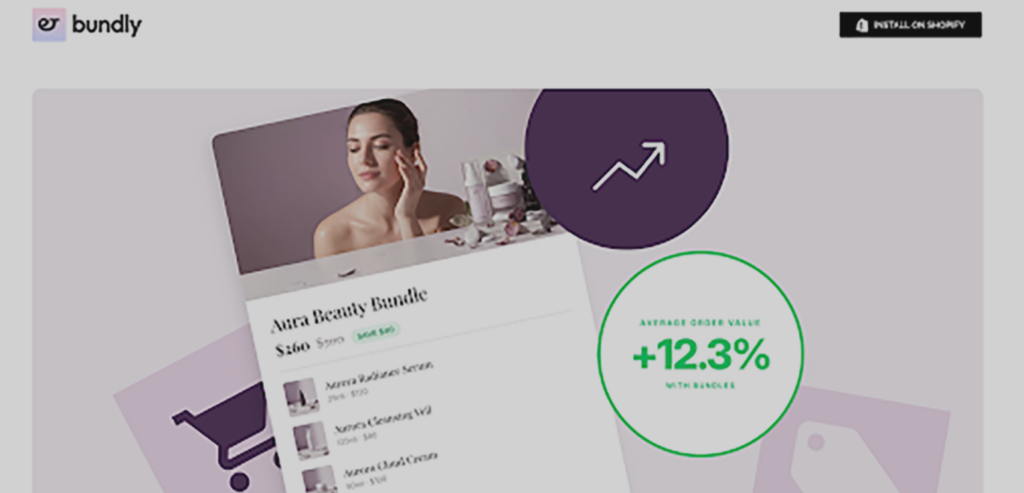
Apps like Bundly can help automate these bundle configurations directly within your storefront, making setup and testing faster without needing custom development.
Using Data to Build Bundles That Convert
Guessing which products to bundle is a recipe for slow-moving inventory and disappointed customers.
Your ecommerce analytics already contain the answers
Pull a co-purchase report from your last 90 days of orders.
Look for product pairs or trios that show up together in at least 5% of transactions.
Those natural pairings convert best as bundles because they reflect real shopping behavior, not your merchandiser’s assumptions.
Testing matters.
Run A/B tests on bundle composition, pricing, and placement for at least two full weeks before declaring a winner.
Conversion rate on the bundle page isn’t the only metric.
Track overall AOV, units per transaction, and return rate.
Some bundles convert well but generate more returns because the added items weren’t genuinely wanted.
Common Mistakes That Undermine Bundle Performance
Forcing products together that don’t make logical sense is the fastest way to erode trust.
A customer shopping for a laptop sleeve doesn’t want it bundled with a phone case just because both are accessories.
Relevance is non-negotiable.
Over-discounting is the second trap.
If your bundle discount exceeds 25-30%, customers start questioning the original pricing.
It can also train shoppers to wait for deals rather than buying at full price.
Ignoring inventory management creates operational headaches too.
If one item in a three-product bundle goes out of stock, the entire bundle breaks.
Map your bundle SKUs to individual inventory counts so stock issues surface before a customer hits a dead end at checkout.
Stacking AOV Strategies Beyond Bundling
Bundling works best as part of a broader AOV strategy rather than standing alone.
Free shipping thresholds remain one of the most effective tools.
Set yours just above your current average order value and watch carts grow to clear the bar.
If AOV sits at $52, a $65 free shipping threshold gives customers a concrete reason to add one more item.
Volume discounts, loyalty program point multipliers on larger orders, and personalized upsell recommendations all stack well alongside bundling.
The merchants who consistently grow their average order value ecommerce-wide treat it as an ongoing optimization loop, not a one-time project.
They test, measure, adjust bundle compositions quarterly, and retire underperformers quickly.
Acquiring customers is expensive and getting more so every quarter.
Extracting more value from each existing transaction through intelligent bundling improves revenue, margins, and customer satisfaction simultaneously, provided you build bundles from real data, price them with margin discipline, and place them where shoppers are already making decisions.
Favorite