


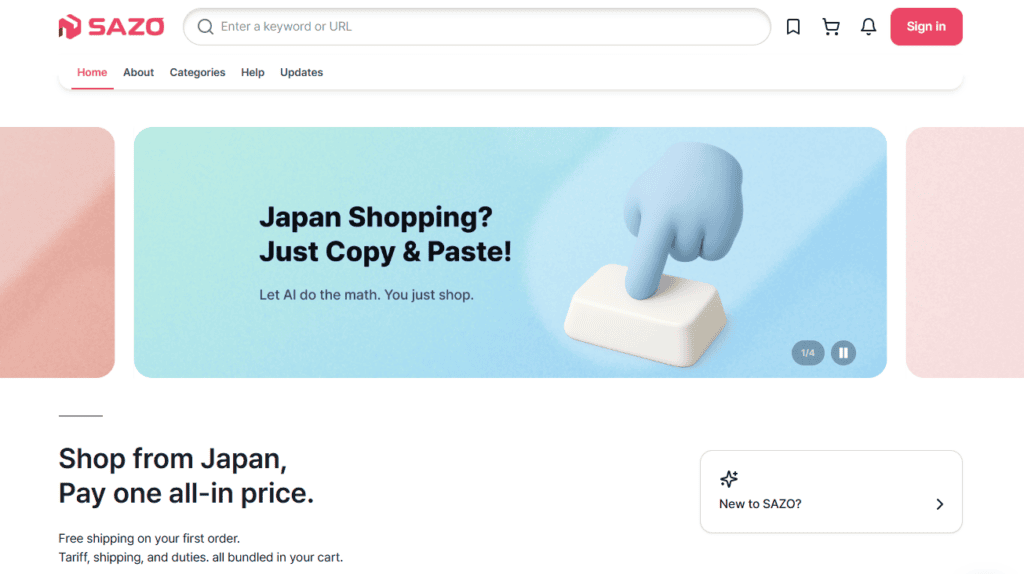
Agentic artificial intelligence (AI)-powered cross-border commerce company Sazo wants consumers to be able to buy from other countries as easily as they shop at home, according to chief financial officer Gavin Jung.
Sazo began by offering cross-border commerce from South Korea to Japan in early 2024. It then added Japan to Korea in June 2025. Now, Sazo has entered the U.S. market, as of June, where shoppers using the platform can make purchases from Japan.
Sazo’s headquarters are in Nagoya, Japan. It has offices in Tokyo and Seoul, and it plans to open another in California in the next year, Jung said.
“And the macro backdrop is almost counterintuitive,” Jung told Digital Commerce 360. “Trade is getting more restrictive. The U.S. ended its de minimis duty exemption, and yet cross-border demand keeps rising, actually. And what changed it is the game. It used to be about duty-free tricks to keep prices low. Now, it’s about who absorbs customs more smoothly for the shoppers, and that shift actually plays to our model.”
Sazo currently only lists products from Korea or Japan, depending on where consumers shop from. For a U.S. consumer, Sazo lists products from Japan. The consumer can then select multiple products, which Sazo then purchases, functioning as a proxy buyer, Jung said. When consumers purchase multiple products through Sazo, the company repackages them to turn them into one shipment before sending it to the customer.
It’s also looking into buying products first — not just when consumers make purchases — to stock and sell with better prices, Jung said.
How Sazo uses AI in its cross-border commerce
“Our AI handles the parts of a cross-border purchase that usually break down, estimating duty and shipping up front, translating listings and consolidating items from different sellers into a single shipment and clearing customs,” Jung told Digital Commerce 360.
The customer pays once in their own currency, he said. Sazo builds the tariffs, duties and international shipping into the price. Its customers don’t have to handle separate customs invoices or foreign exchange surprises later, according to Jung.
He said Sazo is building its technology stack “to be the cross-border back end that AI agents can plug into.” It has plans to develop an application programming interface (API) for AI agents, he said, because it has partners in Japan want to use its technology as a service. That means no matter which AI agents end up leading the market, it won’t matter to Sazo because it can provide back-end services to them, Jung said.

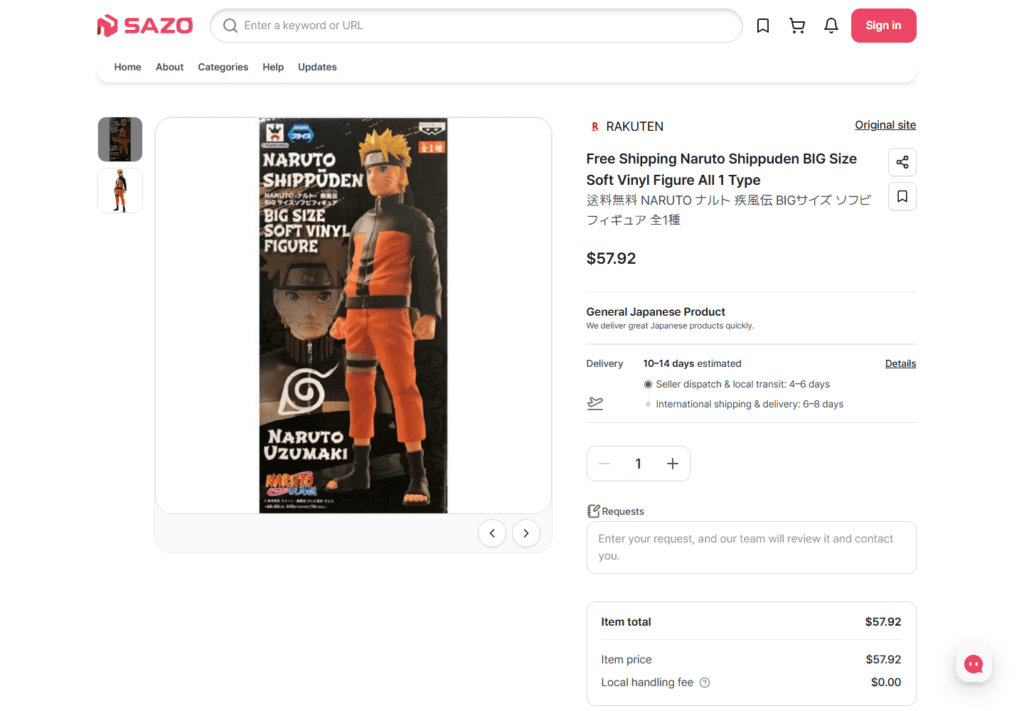
The storefront’s browsing experience includes Japanese inventory shown in English and USD, so it feels like shopping a domestic site, according to Sazo. | Image credit: Sazo press materials
“As AI agents start shopping on people’s behalf, searching, recommending, eventually buying, the models are great at finding a product,” Jung said. “But they can’t clear customs, predict duty by HS code, or run local fulfillment. That execution layer is exactly what we own.”
Sazo raises more than $10 million in funding
Sazo’s CEO, Maro Gil, founded the agentic AI-powered company in 2023. He built the business while studying in Nagoya as a student from Korea studying abroad.
“Nagoya is not Tokyo,” Jung said. “It’s a very humble place. … Nagoya is a quieter city than Tokyo, and even though Korea is close, the products he wanted weren’t easy to get.”
Gil wanted to buy products from Korea tied to his hobbies, but he realized it was difficult despite the countries’ physical closeness, Jung said. That’s when the idea hit him that, because he was studying AI, he could develop technology related to such purchases.
“And as you can imagine, it was his prototype and it was his first product,” Jung said. He added that it was Gil’s first prototype, “built on his own while he was studying, so it was rough at the start — and it’s come a long way since.”
Sazo recently raised $10.3 million in a Series A funding round. Japan Post Capital and Suzuyo & Co. led the round, having also led Sazo’s pre-Series A financing, Wow Tale reported.
Jung noted that Naver is also an equity investor. Sumitomo Mitsui Banking Corporation (SMBC) and Mizuho Bank have provided Sazo with credit financing. Other investors include Japanese venture capital firm Partners Fund and D4V (Design for Ventures).
“Our global service has grown rapidly, with monthly gross merchandise value increasing roughly sevenfold over the past six months,” Gil said, as Wow Tale reported. “Building on this investment, we plan to hire talent across development, service operations, and other areas, and accelerate our efforts to build a cross-border ecosystem that connects consumers and businesses worldwide.”
Cross-border shopping trends in South Korea and Japan
Currently, Sazo is growing 25% month over month, Jung said. He said although her wouldn’t consider Sazo’s customers in Korea and Japan to be too different, he has noticed differences in their shopping trends.
Japanese customers buying from Korea tend to purchase products related to K-pop stars. But there are also consumers there buying food from Sazo. In Japan, Sazo customers tend to be younger and mostly male.
Meanwhile, in Korea, Sazo customers tend to be mostly females in their 30s or 40s, he said. But he expected mostly teenagers or young adults in their 20s. In Korea, he said, more than half of Sazo customers are in their 30s and 40s.
Jung said he was shocked to see Sazo’s average order value (AOV), which is more than $100. He said he expected consumers would use Sazo for cheap purchases. In addition, AOV is smaller among Sazo customers in Japan than those in Korea, Jung noted.
“But people actually don’t just cut down the money when it comes to buying something they really want to enjoy for their hobbies or something they really want to appreciate,” Jung said. “And especially collectors who are passionate about Japanese anime and characters — they’ll invest real money in what they love.”
Do you rank in our databases?
Submit your data and we’ll see where you fit in our next ranking update.
Sign up
Stay on top of the latest developments in the online retail industry. Sign up for a complimentary subscription to Digital Commerce 360 Retail News. Follow us on LinkedIn, X (formerly Twitter), Facebook and YouTube. Be the first to know when Digital Commerce 360 publishes news content.
Favorite